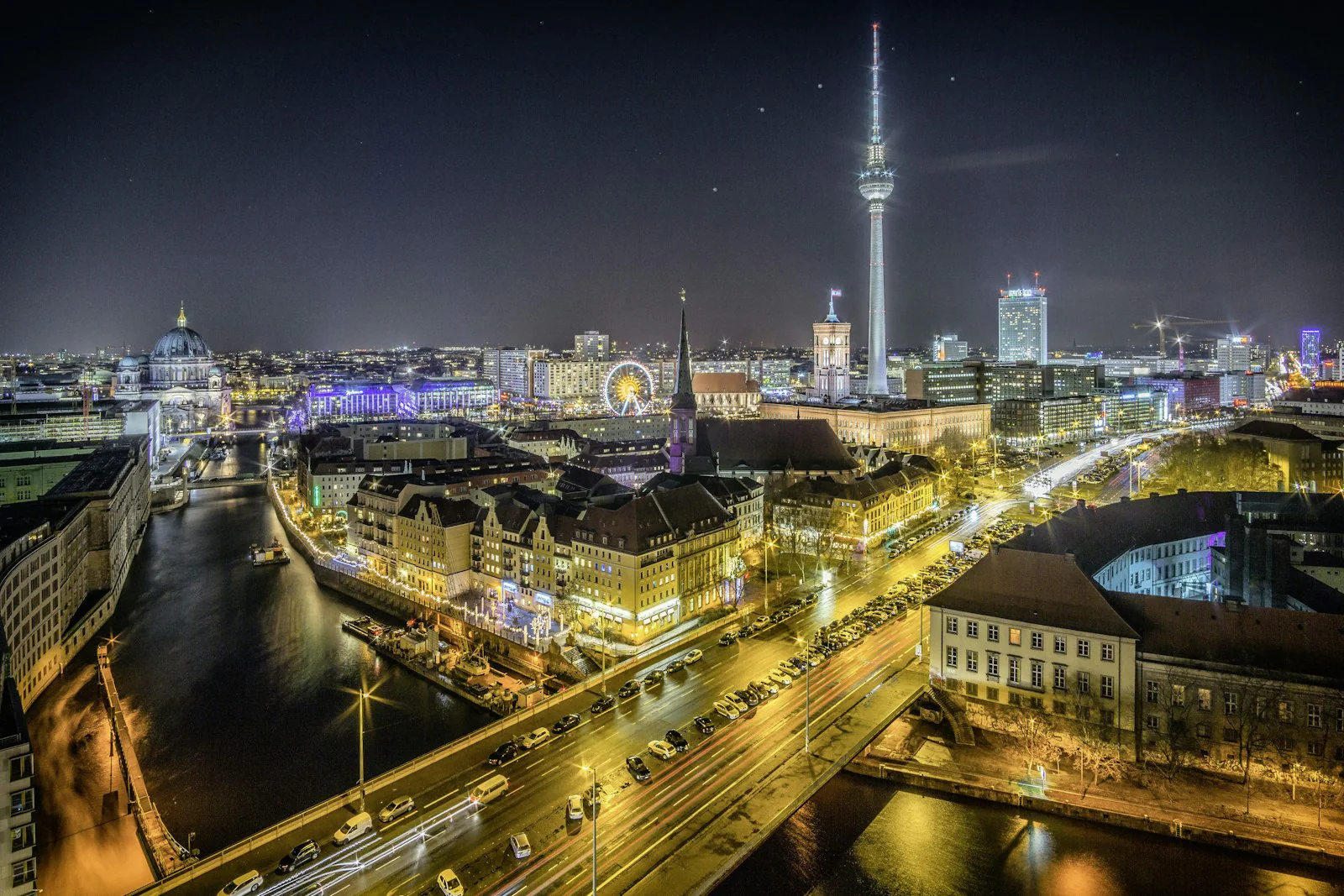
Berlin
The German capital reunified — a metropolis built from two half-cities stitched back together after 1990, and it shows: Cold War scar tissue (the Wall's East Side Gallery stretch, the Soviet memorial at Treptow) sits blocks from glass-and-steel rebuilding at Potsdamer Platz, while the outer districts run their own independent lives, from Kreuzberg's Turkish-German streets to Prenzlauer Berg's café culture. There is no single walkable core the way Vienna or Prague has one — Berlin runs on its U-Bahn and S-Bahn network, and a trip here means picking a base by transit line, not by nearness to the Brandenburg Gate.
History Nightlife Art Alternative culture Food Transit Architecture
Verified highlights
Botanical Garden BerlinGarden
Step-free
43 hectares and around 20,000 plant species make this one of the world's largest and most important botanical gardens, part of the Freie Universität — a genuine half-day if you cover both the tropical glasshouses and the outdoor collections.
Café Einstein Unter den LindenFood
Vegetarian options Vegan options Cards OK Step-free
A Viennese-style coffeehouse a few doors from Bebelplatz and the State Opera, running since 1996 and best known for its Wiener Schnitzel.
Jewish Museum BerlinMuseum
Step-free
The core exhibition is free to visit; a ticket (around €10) is only needed for temporary exhibitions in the Old Building.
Konnopke's Imbiss (Currywurst Stand)Food
Vegetarian options Vegan options Cards OK Step-free
A Berlin currywurst institution operating since 1930, under the elevated U2 tracks at Schönhauser Allee.
Brandenburg GateLandmark
Step-free
Berlin's neoclassical city gate, topped by the Quadriga chariot, anchors Pariser Platz where Unter den Linden begins — a free, unticketed, fully pedestrianised square with no vehicle traffic.
Konditorei DamaskusFood
Vegetarian options Alcohol-free Cards OK
A Syrian sweets bakery on Sonnenallee's Arab-heritage stretch — trays of baklava, knafeh and other Levantine pastries sold by weight, best eaten standing at the counter or taken to Tempelhofer Feld nearby.
Memorial to the Murdered Jews of EuropeHistoric site
Step-free
2,711 concrete stelae of varying height cover a full city block with no gates and no ticket — always open, always free, and it's the single memorial most first-time visitors walk into unplanned on the way between the Gate and the government quarter.
Schwarzes CaféFood
Vegetarian options Vegan options Step-free Cash only
A Savignyplatz-area institution that barely closes — open from 08:00 (10:00 on Tuesdays) until 03:00 the next morning, every day, doubling as an after-midnight refuel near the Kantstraße bars.
Neighbourhoods
Brandenburger Tor & the Government Quarter
Berlin's ceremonial front door — the Brandenburg Gate anchors Pariser Platz, and Unter den Linden runs east from it past Humboldt University and the opera house toward the Museum Island bridges. The Reichstag's glass dome is a five-minute walk north across the Spree, and the sombre concrete grid of the Holocaust Memorial sits just south of the Gate itself. This is the day for the postcard shots and the 20th-century weight behind them; the crowds thin fast once you turn off the main boulevard.
Museum Island & Alexanderplatz
Five museums packed onto one river island make this a genuine full day — though the Pergamon Museum itself has been closed for years of renovation work, so the Neues Museum's Nefertiti bust, the Altes Museum's antiquities and the Alte Nationalgalerie's 19th-century paintings carry the day for now. Cross the Spree east and the mood flips completely: cobbled Nikolaiviertel's reconstructed old-town lanes give way to Alexanderplatz's Communist-era plaza and the needle of the Fernsehturm, whose observation deck is the highest view in the city short of a flight.
Prenzlauer Berg & Kollwitzkiez
The district gentrification remade block by block — Kollwitzplatz's square is ringed with pram-friendly cafés and a Saturday organic market, and the streets around it hold Berlin's highest concentration of restored Altbau apartment facades. Mauerpark at the northern edge does double duty as a Sunday flea market and, once the stalls clear, an open-air karaoke crowd that's been running for over a decade. Slower and more residential than anything in the city centre, and correspondingly better for a lazy morning.
Kreuzberg & the Landwehrkanal
Kottbusser Tor sits at the messy, loud heart of it, but walk five minutes any direction and the neighbourhood softens — south to Bergmannkiez's flower-lined Bergmannstraße and Viktoriapark's small Alpine-style waterfall, or along the Landwehrkanal to Maybachufer's Tuesday and Friday Turkish market. Oranienstraße's bars and Görlitzer Park pick up after dark, when this becomes one of the city's real nightlife centres rather than a daytime sightseeing stop. Expect graffiti, döner stands doing genuine trade rather than tourist theatre, and a Turkish-German community that shaped the neighbourhood long before it got trendy.
Neukölln & Tempelhofer Feld
The old Tempelhof Airport's runways are now the largest open field in the city — no trees, no fences, just kilometres of tarmac and grass where Berliners kite-surf on rollerblades, barbecue and fly actual kites. Schillerkiez, the streets pressed against its western edge, went from cheap-and-rough to the city's most talked-about café strip within about a decade, and Karl-Marx-Straße further north still runs the older, grittier, more Turkish-Arab Neukölln that predates the hype. Come for the field's open sky, stay for whichever version of the neighbourhood you land in.
Friedrichshain & the East Side Gallery
The East Side Gallery turned 1.3 kilometres of the last standing stretch of Berlin Wall into an open-air mural gallery — Dmitri Vrubel's 'Fraternal Kiss' is the one everyone photographs. Walk inland from the river and the neighbourhood shifts into the RAW-Gelände, a former railway repair yard now packed with clubs, a skate park and a Sunday flea market, and Boxhagener Platz's own weekend market and beer-garden square. Less polished than Prenzlauer Berg across the river, and proud of it.
Charlottenburg & the Kurfürstendamm
Schloss Charlottenburg's Baroque palace and its formal gardens are Berlin's answer to a royal-residence day out — smaller than Sanssouci in Potsdam, and close enough not to need a train ticket. East along Bismarckstraße and the Kurfürstendamm (a direct bus or U-Bahn hop, not a walk), the mood turns to department stores, flagship boutiques and the war-scarred bell tower of the Kaiser Wilhelm Memorial Church, left half-ruined on purpose beside its 1960s replacement. This is Berlin's old West-side city centre, still functioning as one.
Tiergarten & Potsdamer Platz
Tiergarten is Berlin's Central Park equivalent — a genuine forest cut through by the Straße des 17. Juni, with the gilded Victory Column marking its centre and enough shaded paths to lose the crowds entirely. At its southern edge, the Kulturforum's Gemäldegalerie and Neue Nationalgalerie hold Old Masters and modernist icons respectively, and Potsdamer Platz itself — flattened by wartime bombing, split by the Wall, rebuilt from scratch after 1990 — is now glass towers and the Sony Center's canopy, a working reminder of how completely the city reinvented its own centre.
Moabit & the Hauptbahnhof
Most visitors only see Moabit through a train window on the way out of the Hauptbahnhof, which is exactly why it's worth the walk across the Spree — the Arminiusmarkthalle, a cast-iron 1891 market hall, runs food stalls and small producers with none of the tourist markup, and the district's Turkish, Arab and North African communities make it one of Berlin's most genuinely mixed. The government quarter's modern glass across the river is visible the whole way, a strange backdrop for such an unpolished neighbourhood.
Schöneberg & Nollendorfplatz
Winterfeldtplatz runs one of the city's best Saturday markets, farm produce and flowers packed into a square otherwise ringed by quiet residential streets and pre-war apartment blocks. Walk east and the mood shifts at Nollendorfplatz, whose U-Bahn station marks the historic centre of Berlin's gay nightlife scene, well before David Bowie and Iggy Pop lived a few streets away in the 1970s; keep going and Tauentzienstraße ends at KaDeWe, continental Europe's largest department store.
Treptower Park & the Soviet Memorial
Treptower Park's riverside lawns are calm enough on their own, but the reason to come is the Soviet War Memorial buried inside it — one of the largest Soviet military cemeteries and monuments outside Russia, with a bronze soldier statue towering over the mass graves of thousands of Red Army dead. It's a genuinely sobering half-day, best paired with a slow walk along the Spree toward the Molecule Man sculpture rising out of the river, rather than crammed next to something louder.
Dahlem & the Botanical Garden
Berlin's museum quarter for the campus, not the tour bus — the Ethnologisches Museum's collections (partly relocated into the Humboldt Forum, so check what's actually on site before committing a day) sit inside the Freie Universität's leafy grounds, a short walk from the Botanical Garden's tropical glasshouses and one of Europe's largest botanical collections. Quiet, academic and almost entirely free of the crowds that fill Museum Island, with Grunewald's forest edge a few stops further out for anyone who wants to keep walking.
Wannsee & Pfaueninsel
Berlin's inland beach day — Strandbad Wannsee is one of Europe's largest lake lidos, sand imported decades ago and still packed on any warm weekend. A short ferry from the jetty crosses to Pfaueninsel, a genuinely car-free island landscaped as an 18th-century royal folly, peacocks included. The Haus der Wannsee-Konferenz on the lake's eastern shore, where the 1942 meeting that planned the Holocaust's logistics took place, sits a deliberate, heavy contrast a short walk from all the swimming.
Where to stay
Brandenburger Tor & the Government Quarter
Central on both the U-Bahn and S-Bahn rings, with most marquee sights inside walking distance — the most expensive and most tourist-heavy base, best for a short trip built around the postcard sights.
Friedrichshain & the East Side Gallery
Warschauer Straße's U1-plus-four-S-Bahn-line interchange puts the whole city within reach for less than a room in Mitte costs, with the neighbourhood's own nightlife on the doorstep.
Prenzlauer Berg & Kollwitzkiez
One U2 stop from Alexanderplatz, with better café and restaurant density than the centre and a genuinely liveable, family-friendly street pattern to return to each evening.
Schöneberg & Nollendorfplatz
Nollendorfplatz is a four-line U-Bahn interchange in the middle of a genuinely residential, mid-priced neighbourhood — well connected without Mitte's markup.
Charlottenburg & the Kurfürstendamm
Zoologischer Garten's rail-and-U-Bahn interchange made this Berlin's old West-side centre, and it still functions as one — practical for business trips and for arriving by long-distance train.
Some links may earn hi tabi a commission, at no extra cost to you.
Getting there
Berlin Brandenburg Airport (BER)
About 24 km south-east of the centre. The Airport Express (FEX) and regional trains (RE7, RB14) reach Hauptbahnhof in roughly 30 minutes; the S-Bahn (S9, S45) is slower but covers more inner-city stops along the way. BER replaced both Tegel and Schönefeld airports, which are now closed.
Berlin Hauptbahnhof
The main long-distance station, on the Spree at the northern edge of the government quarter. Deutsche Bahn's ICE and IC trains run from here to Amsterdam, Prague, Munich and beyond — build in schedule slack, since DB's long-distance punctuality is a real and current problem, not just a running joke.
FAQ
What is Berlin best for?
Berlin is best for History, Nightlife, Art, Alternative culture, Food, Transit, Architecture. The German capital reunified — a metropolis built from two half-cities stitched back together after 1990, and it shows: Cold War scar tissue (the Wall's East Side Gallery stretch, the Soviet memorial at Treptow) sits blocks from glass-and-steel rebuilding at Potsdamer Platz, while the outer districts run their own independent lives, from Kreuzberg's Turkish-German streets to Prenzlauer Berg's café culture.
How up to date is this information?
Every place in the catalog is human-checked, and volatile facts — opening hours, closures, payment — sit on a quarterly re-verification cycle. Plans and pages are regenerated with every site release, so what you read reflects the current catalog.