ViennaWien
An imperial capital that kept its scale — Habsburg palaces and world-rank museums inside the Ring, and beyond it the coffee houses, markets and wine taverns the city actually lives in. Dense, walkable, and served by one of Europe's best transit networks.
Museums Coffee houses Music Walkable Wine
Verified highlights
Vienna Botanical GardenGarden
Step-free
Vienna's university botanical garden, tucked right behind the Belvedere gardens — free admission, and open daily year-round except 24 December to 6 January.
Salm BräuFood
Vegetarian options Vegan options Cards OK Step-free
A brewpub in the former monastery buildings a few minutes below the Belvedere, brewing on site and serving the ribs and schnitzel to match.
Lower BelvedereMuseum
Step-free
Prince Eugene's actual residence at the foot of the garden, where the Upper Belvedere was only for entertaining.
Stöckl im ParkFood
Vegetarian options Vegan options Cards OK Step-free
A restaurant-brewery in the Schwarzenberggarten right beside Belvedere, brewing its own beer on site.
Beethoven MuseumMuseum
Step-free
The Heiligenstadt house where Beethoven wrote the letter admitting his deafness in 1802, now a museum across several floors of the old wine-grower's building.
Feuerwehr WagnerFood
Vegetarian options Vegan options Cards OK Step-free
One of Grinzing's best-known Heuriger, with a shaded natural garden for 450 and a buffet that explicitly lists vegetarian, vegan and gluten-free dishes next to the usual roasts — unusual for this style of place.
Grinzing CemeteryHistoric site
Step-free
A working cemetery on the vine slopes above the village, and the resting place of Gustav Mahler — his grave carries only his name, cut into a plain stone block at his own request, in group 6, row 7.
Mayer am PfarrplatzFood
Vegetarian options Vegan options Cards OK Step-free
A working Heuriger in the house Beethoven rented in 1817, where he worked on the Ninth Symphony — his rooms are still up the stairs from the terrace.
Neighbourhoods
Innere Stadt & Stephansdom
The medieval core inside the Ring, built around the cathedral's tiled roof. Graben and Kohlmarkt for the grand shopfronts, narrow lanes behind them for the old coffee houses. Everything here is walkable and everything here is priced accordingly — eat a street back from the main squares.
Hofburg Imperial Palace
The Habsburgs' winter palace, still a working quarter of state rooms, libraries and stables rather than a single museum. The Spanish Riding School trains here in the mornings. Plan it as a half-day at least — the imperial apartments, treasury and national library are separate tickets and separate hours.
MuseumsQuartier & Maria-Theresien-Platz
Two vast imperial museums facing each other across a square, and behind them a former stables block turned into courtyards, modern galleries and the city's most reliable place to sit outside with a drink. A full day if you go into the Kunsthistorisches properly; an afternoon if you do not.
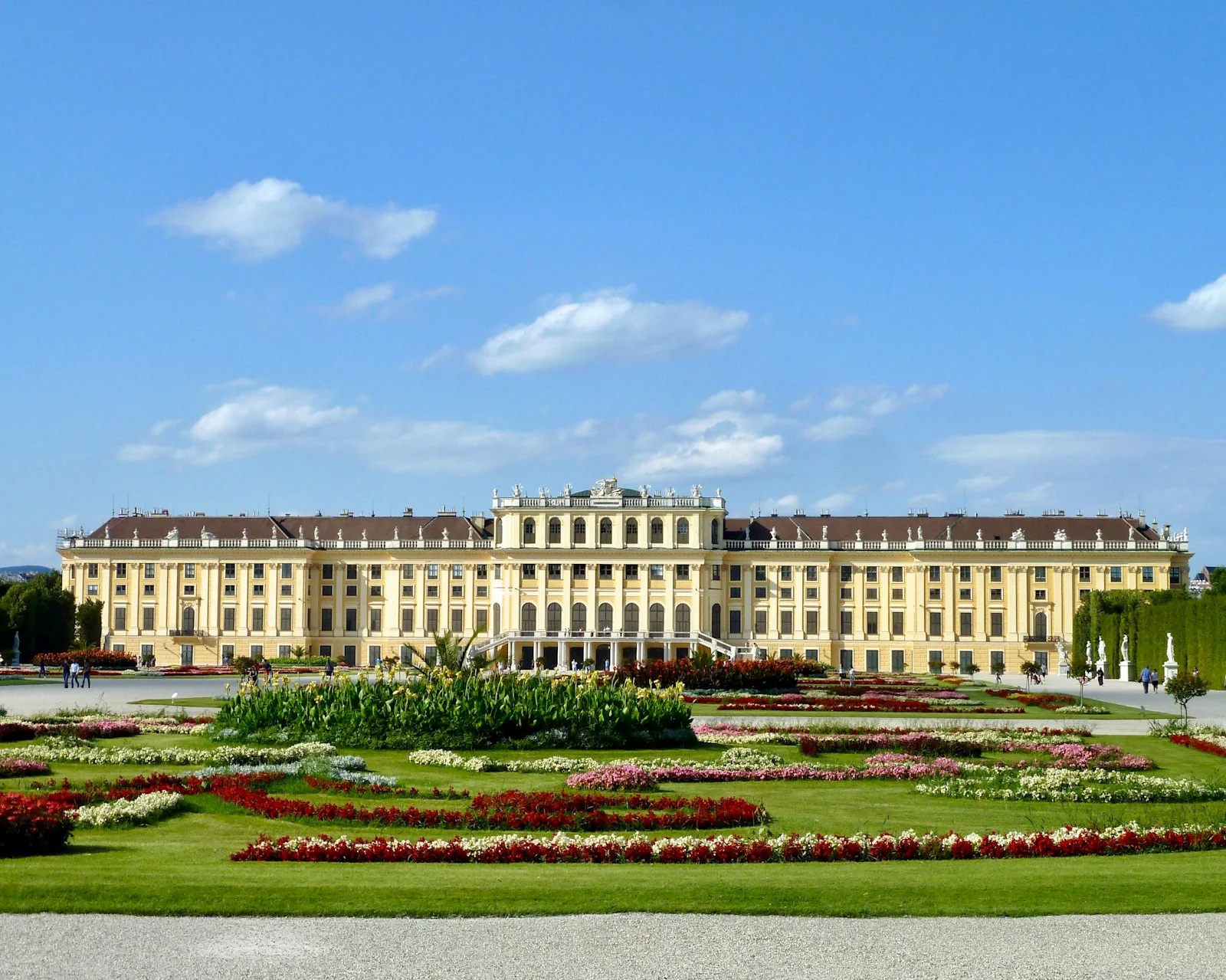
Schönbrunn Palace & Gardens
The summer palace, its formal gardens climbing to the Gloriette, and the world's oldest surviving zoo in the same grounds. This is a full day on its own and should be planned as one — palace tickets are timed, the gardens are free, and the walk up to the Gloriette view is longer than it looks.
Belvedere Palace
Two baroque palaces on a slope with a formal garden between them, and the reason most people come: Klimt's Kiss hangs in the Upper Belvedere. Smaller and more manageable than Schönbrunn — half a day, and the garden between the two palaces is free to walk.
Naschmarkt & Karlsplatz
The long market strip and the streets either side of it, running down from Karlsplatz where the Secession's golden dome and Karlskirche sit almost opposite each other. This is where Vienna eats — market stalls, Levantine food, and the Saturday flea market at the far end.
Prater & Leopoldstadt
The giant ferris wheel and the old funfair at one end, and behind them several square kilometres of flat woodland and avenues that Viennese families actually use. Good for a half-day with children, and the one green space in the city big enough to lose the crowds in.
Brunnenmarkt & Yppenplatz
The longest street market in the city and the district around it — Turkish and Balkan groceries, and at the Yppenplatz end a run of cafés and small restaurants that draw people across town at the weekend. Almost no tourists, and the best value eating in Vienna.
Grinzing & Heiligenstadt Wine Villages
A wine village swallowed by the city but still working, on the vine slopes at the northern edge. Heuriger taverns serve their own new wine from a buffet counter, opening in irregular seasonal stretches rather than to fixed hours. An evening rather than a day, and worth pairing with the ridge walk above it.
Landstraße & Hundertwasser
The third district east of the Ring, where Hundertwasser's undulating social housing and the gallery he built nearby broke every rule Vienna's architecture had. Ordinary residential streets in between, and the Danube canal path at the edge — a half-day, and a useful contrast after a week of imperial baroque.
Kahlenberg & the Vienna Woods
The wooded ridge closing the city to the north, where the vineyards stop and the Vienna Woods begin. The terrace at the top looks down the Danube over the whole city, and the ridge path between Kahlenberg and Leopoldsberg is the classic walk — an afternoon, best paired with a Heuriger on the way back down.
Where to stay
Innere Stadt & Stephansdom
Inside the Ring: everything marquee is on foot, every U-Bahn line is a few minutes away, and it is the most expensive part of the city. Best if your days are museum-heavy and your trip is short.
Naschmarkt & Karlsplatz
Around Karlsplatz and the Naschmarkt — four U-Bahn lines meet here, the eating is better and cheaper than inside the Ring, and the centre is a ten-minute walk or one stop away.
Some links may earn hi tabi a commission, at no extra cost to you.
Getting there
Vienna International Airport (VIE), Schwechat
About 18 km south-east. The City Airport Train and the S7 suburban line both reach the centre; the S7 is far cheaper and only a little slower.
Wien Hauptbahnhof
The main station, and where trains from Prague, Budapest, Munich and Venice arrive. U1 runs from here into the centre in minutes.
FAQ
What is Vienna best for?
Vienna is best for Museums, Coffee houses, Music, Walkable, Wine. An imperial capital that kept its scale — Habsburg palaces and world-rank museums inside the Ring, and beyond it the coffee houses, markets and wine taverns the city actually lives in.
How up to date is this information?
Every place in the catalog is human-checked, and volatile facts — opening hours, closures, payment — sit on a quarterly re-verification cycle. Plans and pages are regenerated with every site release, so what you read reflects the current catalog.